STAR WARS: MACBETH

A high-school movie from February 1997

The Force is with Macbeth.

Three brave Scots. One throne. A cafeteria, a gymnasium, and lightsabers. George Lucas meets William Shakespeare in an odyssey made with a Sharp Viewcam, a fishing rod, a toy Millennium Falcon, and whatever computer time we could get.

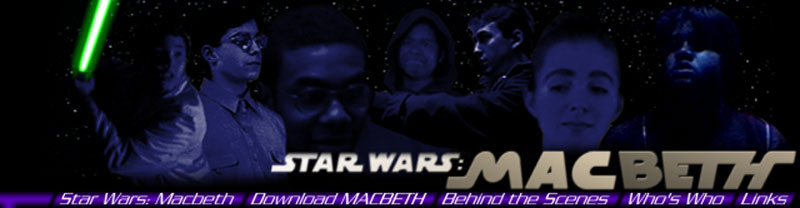
The original Star Wars Macbeth website banner
Recovered web artworkFirst published 1998

Created for an English project, Star Wars: Macbeth received rave reports at Glen Ridge High School. Its creators—that’s us!—decided it was worth putting up on the ’net. We enjoyed every part of making it, from the script to the “elaborately” staged battle scenes. Did I mention they had lightsabers?

Thirty years later

Revisiting Star Wars: Macbeth in 2026

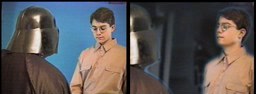
In 1997 this was an English project, a winter-vacation movie, and an excuse to see how much trouble we could cause with a video camera without actually damaging the school. We were reading Macbeth. The Star Wars Special Editions were back in theaters. We wanted to make something huge. We had no money. None of us could act. We had one dangerous halogen lamp and several friends who could be begged into costumes. So we mixed ’em together. The hallway became the Empire, the gym became a launch bay, and a white plastic rod became a lightsaber after Bienvenido C. spent an unreasonable amount of time painting over it one frame at a time.

Robert Rodriguez—director of El Mariachi and author of Rebel Without a Crew—gave us a rule we could actually use: make the movie out of the locations, props, people, and gear you already have. Our version was a Sharp Viewcam, a $100 capture card, a blue carpet, plastic rods, a fishing rod, Photoshop, and friends willing to spend vacation inside school. It looks homemade because it was. Good.

The small, strange academic afterlife

Then the academics arrived.

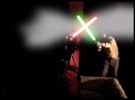
In 2003, Henry Jenkins included Star Wars: Macbeth in “Quentin Tarantino’s Star Wars?”, an argument he later reworked for his 2006 book Convergence Culture: Where Old and New Media Collide. He used the locker-hallway lightsaber fight and the Millennium Falcon leaving the gym as examples of a new kind of public movie: inexpensive cameras, desktop editing, and the Web turning audiences into filmmakers. We did not invent fan film. Obviously. We were high-school students making an English project with toy spaceships and whatever software we could make behave. But the movie escaped the classroom, which made it useful evidence that the larger change was happening. Courtney Lehmann went much further in “Out Damned Scot”, finding arguments about Glen Ridge, race, history, globalization, and transnational Shakespeare in it. Some of that is sharp. Some of it is spectacular academic overreach. None of it was on our shooting outline, which was closer to: get into the school, do not break the lockers, and finish before vacation ends.

Then it got weirder. In 2005, The Guardianrecommended the site to British teachers and pupils. Other teachers used the movie to teach Shakespeare. In 2019, Jim Caseycalled it an early example of students digitally remastering William Shakespeare, then asked the sensible teacher question: does remix bring students into the play, or give them a clever way around reading it? And then, in 2023, Arpita Pal used the movie as evidence in a broader case against “mix and match Shakespeare,” which she argued can lose the language, context, philosophy, and sombre seriousness of the original. In other words, the backlash finally arrived, twenty-six years late. We replaced Birnam Wood with the Rebel Alliance and ended with Macbeth’s smiling severed head at the medal ceremony. These are obscure pieces; we are not pretending anybody was waiting for them. But a few academics eventually argued about our lightsabers. We were delighted.

Watch it · download it

The movie. The trailer. The mistakes. CNN, somehow.

One surviving copy of each. You press play; it plays. This is a major improvement over 1998. No player installers, obsolete WMV duplicate, or four-part download required.

CNN Showbiz Today · 1:39

The surviving television report

This is the real segment. It surveys the early online fan-film world, visits TheForce.net, and actually shows the Star Wars: Macbeth site and green-saber footage. This MP4 is the best recovered version for normal playback. The original WMV remains preserved offline, where obsolete WMV files may live in peace.

How we made it

We spent winter vacation inside the school we had just escaped.

This account follows the original production story and 1999 interview. Where memories disagree, the disagreement is kept instead of tidied away.

01

The idea arrives after the bell

We were studying Macbeth, Star Wars was back in theaters, and Bienvenido C. came flying into a classroom with an idea: combine them. The similarities were waiting for us—prophecy, betrayal, dysfunctional families, headstrong heroes, political violence, and a villain who needed removing. The simpler explanation is that we wanted to make Star Wars and school wanted us to do Macbeth. The rest was history. Or chemistry.

02

Michael writes a very fast script

Michael M. assembled the final act of William Shakespeare’s play, dialogue and situations from George Lucas’s trilogy, and new connective material into what the original profile proudly called a “compellation.” The first draft took about three hours. Macbeth became Darth Vader. Macduff became Luke Skywalker. The Rebel Alliance replaced Birnam Wood. The principal and custodians gave us one rule: do not wreck the lockers with the white plastic rods.

03

Four days inside the school

Bienvenido C. arrived with three boxes of equipment and props: a black mask and cape, a yellow jacket, a Sharp Viewcam, two white plastic rods, a bedsheet cape, and one extremely hot halogen lamp. A school cart became a noisy dolly. Pizza and the soda machine handled craft services. Cheerleaders in the gym became a compositing problem, so the Millennium Falcon eventually covered them.

04

Post-production saves us

The raw footage looked like nonsense. Then the editing and John Williams showed up. Don Fitz-Roy shaped the music and sound; Bienvenido C. cut the picture and painted the sabers and lasers frame by frame in Photoshop. The old accounts disagree about whether the computer was a 486 or a low-end Pentium, so we’re keeping both versions. Either machine was being asked to do things it had not volunteered for.

05

We held the tape in our hands

The cast watched the finished tape the night before school resumed. We laughed at the acting, the accidents, and the ridiculous scale of the thing. Then Bienvenido C. cut the trailer, and it was ridiculously cool. We watched those ninety-eight seconds over and over. The trailer took everything that worked—the sabers, John Williams, the Falcon, the pure nerve of it—and made our high-school project feel like an actual movie.

06

Then the tape escaped

The old FAQ says AP Chemistry saw it first. Don’s 1999 interview says English. Apparently he started revising history early. Either way, people asked to watch it again and copies circulated. We put the trailer on TheForce.net; enough people responded that we digitized the whole movie and split it into four dial-up-sized files. This was before YouTube, when fan films did not arrive in an endless feed. The map we knew was basically TROOPS and, soon afterward, Thumb Wars. Then our strange little movie was on the map too.
How to fake an empire

The effects had two jobs: build the world and distract from the acting.

In high school, you can get away with this. When you are making a $100 million movie, you need effects, acting, and a story. Keep this in mind. :-)

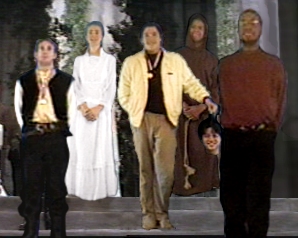
The Star Wars Macbeth cast composited into the throne-room ceremony
We replaced the whole scene.We were watching the medal ceremony from A New Hope, trying to find an ending, when the reasonable idea arrived: put our cast directly into it. A blue carpet covered Bienvenido C.’s bedroom wall; the actors walked in front of it; MediaStudio removed the blue; and four people from Glen Ridge High School walked down the aisle inside the movie. It was difficult, it had a few glitches—Princess Leia’s hair never entirely agreed to the plan—and it worked.

01 · Blue screen

Blue carpet, blue screen.

A blue carpet stretched across Bienvenido C.’s bedroom wall. MediaStudio selected and removed the blue, leaving a transparent area into which a Death Star interior could be placed. Nobody could wear blue unless disappearing was part of the scene. The same basic process put the cast into the final awards ceremony, glitches, difficult hair, and all.

02 · Rotoscoping and animation

Thirty frames per second. You do the math.

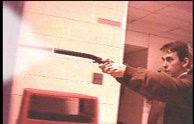
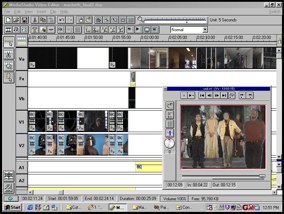
Blaster bolts were animated lines moving toward or away from the camera. The lightsaber fights began as white plastic sticks, then acquired colored cores and translucent glow one frame at a time in Photoshop. Each video clip was exported as a “reel”: one long image with its frames stacked vertically, like literal film. After aligning the window to exactly one frame, Bienvenido C. used the scroll bar’s pager to move through that single image frame by frame. It took forever. It also made the fights look flashy, which was probably the point of lightsabers in the first place.

03 · Image mattes

A school window becomes space.

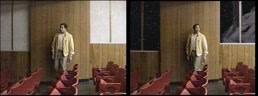
A matte removes a static part of the frame and replaces it. School windows became space; a room behind Macduff acquired a view from The Empire Strikes Back; the gym collected layers until a toy spacecraft appeared to be flying out of it. The camera could not move. If the camera moved, the matte also had to move, and we had enough problems.

04 · Traditional effects

A fishing rod becomes the Force.

Fishing line held up Young Siward’s robe; letting out the line when the saber passed made him disappear. The same equipment pulled Macduff’s saber into his hand. More people asked about that simple trick than about the glowing blades. Go figure.

No still survives. The fishing line does, right there in the movie.

05 · Lighting

One dangerous halogen lamp.

Hallway lights flicked on and off to suggest a station in trouble. The final duel moved to the school stage, where a dark background, red and blue lights, heat, and a full-strength fan created a storm out of the available equipment.

06 · Editing and the Falcon escape

The Millennium Falcon leaves the gym.

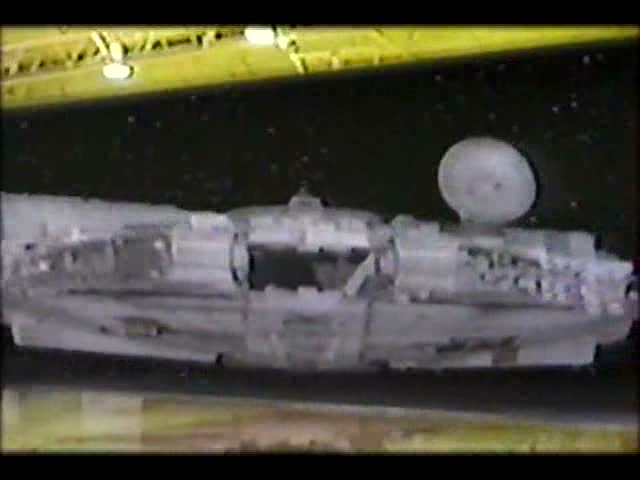
The escape layered the running heroes, a blue-screened toy Falcon, the gym plate, a spacecraft interior, and a handheld fly-by. Robert F.’s image was rotated for hyperspace without a seatbelt. No one would confuse it with real life. With a little imagination, it worked.

Who did what

Seven people made an empire.

We were friends through high school, Star Wars fans, and movie fans in general. We did not necessarily like the same movies. Titanic, for example, divided us between the hopeless romantics and the people rooting for Kate and Leo to sink.

Then and now

Bienvenido C.

Played Macbeth · co-director · editor · effects · executive producer

1998Bien had been acting and producing since he was twelve. By high school he had made Mission: Impossible—Tom and Huck Rescue Jim, other shorts, documentaries, sports-highlight tapes, and the award-winning MusicNet education site. On this movie he cut the picture, played Macbeth in a hot plastic mask, and did the frame-by-frame effects work.

NowHe still works where design, software, and systems overlap, and he remains the person who can explain exactly how the impossible-looking bits were done. In 2026 he corrected the record: the sabers were painted in Photoshop on reel-like images, one stacked frame at a time.

Don Fitz-Roy

Played Macduff · co-director · music and sound · original website

1998The 1998 profile says Don did his best to “whine and look stubborn” as the Luke Skywalker version of Macduff. He co-directed, fitted the John Williams music to the picture, built the first website, studied computer science and film theory at Brown, wrote screenplays, collected soundtracks, and referred to himself in the third person.

NowHe now teaches computer science and robotics. While in college he showed the movie to his summer-camp counselor group; in 2021 he showed it to his own fifth-grade class. Other teachers have used it to teach Shakespeare. He also never really stopped editing—only the subjects, tools, and deadlines changed.

Michael M.

Played Young Siward · screenplay

1998Michael wrote the script from William Shakespeare, Star Wars dialogue, and whatever connective tissue the movie needed—“a compellation,” as the old page put it. He had already written and acted in the earlier Mission: Impossible short, worked as a school-newspaper and yearbook writer and photographer, and won Model UN awards before heading to Duke.

NowHe now teaches politics and international relations and remains involved in departmental leadership. Apparently Model UN and turning Act V into Macduff Strikes Back were not unrelated training.

Raymond P.

Played Han Siward · ideas · costumes · props

1998Ray was already a video-editing enthusiast. His earlier work included Ninja Spirit, a James Bond parody with an actual car chase, and the Star Wars Cantina video. He was also an artist, a runner, and a volunteer ambulance-squad member. During the shoot he helped turn an unplanned moment into the Falcon escape.

NowHe went on to television broadcast operations, routing graphics, prompter feeds, and live-news signals instead of toy spaceships. That is less a career change than a much better-equipped version of the same instinct.

Robert F.

Played Malcolm Calrissian · ideas · costumes · props

1998Robert brought Malcolm into the Rebel Alliance, helped build the movie around what we actually had, and was rotated sideways for hyperspace without the benefit of a seatbelt. In high school he led Model UN, played in the marching band, captained the tennis team, and collected awards at Model UN conferences before heading to Yale.

Carl Erik F.

Played Admiral Seyton · lighting technician · the entire Empire

1998We ran out of people willing to spend vacation inside the school, so Carl played the officer, the guard, and effectively the whole Imperial fleet. He also flicked the hallway lights during the action scenes. Carl did not merely join the Empire. Carl became the Empire.

Rebekah H.

Played Princess Leia · keeper of the Scottish crown

1998Rebekah joined the final ceremony, presented Malcolm with the crown, and survived a blue-screen process that was not especially kind to Princess Leia’s hair.

How this got weird

An English project developed an afterlife.

A copied tape became a website. The website reached CNN, magazines, reviewers, teachers, and eventually people with footnotes. That is an objectively strange career for a high-school movie.

Header from the later DCFR Star Wars Macbeth site

CNN: two different artifacts

Yes, CNN really showed it.

The May 1999 CNN.com article “Star Wars sites clone rapidly on the Web” surveyed the explosion of early Star Wars sites. It does not name Star Wars: Macbeth. It matters because it captures the online culture through which the movie traveled.

The separate Showbiz Today report actually shows our site and footage. For years, those two things got smooshed together. They are not the same artifact.

Read the archived CNN.com article

What actually lasted

Not a blueprint. A permission slip.

Did we influence later movies? Maybe. Can we prove it? No. We can prove people watched it, copied it, taught with it, and eventually complained about it in footnotes. A hallway, a toy spaceship, and enough nerve got us surprisingly far.

Site history · 1997–2026

One tape. Three old websites. A lot of dead video players.

The film dates to 1997. The first website dates to 1998. Later pages and even academic sources blurred those dates; this timeline follows the recovered record and admits what we still do not know.

01

Macbeth wasn’t created. IT ALWAYS WAS.

More precisely: we carried costumes, props, a Sharp Viewcam, white plastic rods, one dangerous halogen lamp, and a fishing rod into Glen Ridge High School. Four principal shooting days were followed by editing, music, blue-screen work, mattes, and frame-by-frame lightsabers.

02

The tape escapes into school

The surviving accounts disagree about which class saw it first: the original FAQ says AP Chemistry, then English; the 1999 interview remembered English first. What they agree on is that people asked to see it again, copies circulated, and classes briefly discovered that Macbeth was more urgent than whatever else they were supposed to be doing.

03

The first website goes online

The Glenridge edition put the movie on the public Web with a Microsoft FrontPage theme, QuickTime and RealMedia files, a production diary, FAQ, profiles, effects notes, and a download divided into four sections for people with heroic dial-up connections.

04

The earliest surviving Web Archive capture

The site had already been online for months, but this is the first root-page snapshot that survives in the recovery record. Later captures preserve far more of the text and artwork.

05

The counselors get a screening

While Don Fitz-Roy was in college, he showed the movie to his summer-camp counselor group. The exact year has not been recovered. This happened long before the fifth-grade screening in 2021, and long before the academics arrived.

06

CNN, print, and the fan-film Web

The surviving CNN report showed the site and a green-saber shot. CMJ printed the address in August 1999. Reason discussed the movie in March 2000. Don’s 1999 no-budget filmmaking column explicitly connected the project to the Robert Rodriguez approach. The exact CNN broadcast date remains unresolved.

07

A purple-and-blue rebuild

The second Glenridge site admitted that links and players were breaking, then added News, expanded production and effects writing, and new QuickTime, RealMedia, and Windows Media files. Much of the restored visual identity comes from this edition.

08

The outtake reel arrives

Another search through the tapes produced the 3:56 reel of mistakes and funny fragments. It is once again available in a normal browser player.

09

The footnotes begin

Henry Jenkins placed the film inside the rise of public digital fan filmmaking. Courtney Lehmann gave it a sustained reading as a screen adaptation of Macbeth. This was more academic attention than the production plan had anticipated.

10

Teachers, Convergence Culture, and “The Force is back”

The Guardian recommended the film to British teachers and pupils in 2005. Henry Jenkins carried the discussion into Convergence Culture in 2006. On 30 April 2006, Don Fitz-Roy relaunched the archive at dcfr.net with remastered QuickTime downloads and a new sliced-image header.

11

Digital Shakespeare finds it again

Jim Casey described the movie as an early instance of students digitally remastering William Shakespeare and used it in a larger argument about teaching digital Shakespeare.

12

Back to fifth grade

Don showed the film to his own fifth-grade class. The students were impressed. His report to the old crew was concise: “That shit holds up decently well.” Bienvenido C. replied that the older the movie gets, the more it needs subtitles. Fair. They did not really have audio equipment.

13

Actual backlash

Arpita Pal cited the movie while arguing that digital “mix and match Shakespeare” can lose the original’s language, context, and seriousness. Twenty-six years after we put Darth Vader into Macbeth, somebody finally objected on scholarly grounds. Amazing.

14

The recovery

In 2026 Don Fitz-Roy went looking through old drives and the Internet Archive with an AI agent. They found the movie, trailer, outtakes, CNN report, screenplay, 1999 interview, effects art, and enough dead websites to make this version possible. The old files stayed untouched; copies people can actually play returned to dcfr.net.

15

This third edition

Bienvenido C. corrected how the sabers were actually done. The surviving pictures, clips, and words were finally matched up. Most importantly, the rebuilt page stopped apologizing for the rough edges and started sounding like the people who made the movie. That is why this version exists.

Preservation note

We fixed the playback. We did not “improve” the past.

The public film, trailer, outtakes, and CNN report are browser copies selected from the best recovered sources for reliable playback. The higher-resolution film, period QuickTime files, original WMV report, raw production tapes, and archived site payloads remain unchanged in the preservation collection. We are simply no longer asking visitors to install a 1999 media player.

The 1998 Glenridge pages provide the voice and production story; the 2000 edition provides the strongest surviving period artwork and News record; the 2006 DCFR edition documents the relaunch. Parked-domain captures and known wrong video links were excluded, because preservation does not require preserving every mistake we made while rebuilding the site.

The tape was never supposed to last thirty years. That may be the best special effect in the movie.