Coming attraction · 1:38
The original trailer
Era of tyranny. Fight for honor. Time for revenge. Tale of fantasy. High-school lockers.
Glen Ridge, New Jersey · February 1997
Don Fitz-Roy and Bienvenido C.’s high-school remix of William S. and Star Wars—recovered from old hard drives and the disappearing web, and restored for a new generation.
The film survived. So did the trailer, outtakes, screenplay, three generations of the website, and the story behind all of it.
The main event
The cleanest surviving public cut, restored to its intended 4:3 frame. William S. provides the tragedy. Star Wars provides the grammar. Glen Ridge High School plays Scotland.
This embedded preservation copy is hosted by Hether L. The recovered archive retains independent local and Wayback masters.
Coming attraction · 1:38
Era of tyranny. Fight for honor. Time for revenge. Tale of fantasy. High-school lockers.
 Open the archived outtakes ↗
Recovered extra · 3:56
The version in which the actors, props, accents, and Force all decline to cooperate.
Period coverage · 1:40
A surviving television segment from the moment fan films were becoming news, years before social video made them ordinary.
Behind the scenes
“We wanted to make a Star Wars video, and we were studying Macbeth in English class.” That was the concept. Everything after it required nerve, pizza, a forgiving principal, and several useful accidents.
Bienvenido C. rushed into chemistry class with the title. Michael M. assembled William S., George L., and original dialogue into Act V: MacDuff Strikes Back. Macduff became Luke; Macbeth became Vader; Malcolm became Lando.
The crew carried three boxes of gear and props across town, then spent vacation filming inside school. A yellow jacket suggested Luke. A bedsheet became Lando’s cape. One industrial fan supplied the epic wind.
Bienvenido C. edited and built the effects; Don Fitz-Roy cut the soundtrack and directed the shots he was not in. The ending placed the whole cast inside A New Hope using a blue carpet stretched across a bedroom wall.
The cast laughed through a private screening, then watched the film stop classes the following week. The school’s reaction turned a finished assignment into something worth sharing beyond the building.
“We had begun something and seen it through to its completion.”
— the original behind-the-scenes accountIndustrial Light & Magic-ish
The effects were homemade, but the underlying techniques—compositing, rotoscoping, mattes, practical rigs, and selective lighting—were the same visual vocabulary used by much larger productions.
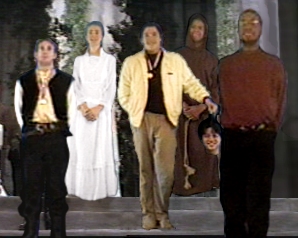
A blue carpet covered Bienvenido C.’s bedroom wall. MediaStudio removed the blue and dropped Macbeth and the Imperial Officer into the Death Star. The same method put the cast inside the closing awards ceremony.
Every lightsaber and laser was painted frame by frame in Adobe Premiere—roughly thirty decisions for every second on screen. Bienvenido C. handled the effects while Don Fitz-Roy assembled sound and John W. music cues.
Static portions of a frame were replaced with starfields and spacecraft. The camera had to stay locked or the matte would give itself away.

A toy Falcon, a hurried shot in a gym full of cheerleaders, blue screen, and a handheld fly-by turned the high-school floor into an escape bay.
The cheapest effect won the most questions: fishing line pulled Macduff’s saber into his hand. The Force cost almost nothing.
Who’s who
The recovered credits tell a collaborative story. Acting was only one job; everybody carried props, solved problems, operated equipment, or became an entire military faction when the cast ran short.
Macbeth
Macduff
Young Siward
Han Siward
Malcolm Calrissian
Admiral Seyton / The Empire
Princess Leia
Where are they now?
Current notes include only identities and work that can be tied responsibly to the original crew. An honest blank is better than a confident wrong person.
Don Fitz-Roy became a science and computer-science educator, teaching through robotics, making, and digital citizenship. In 2026 he is still teaching—and building MyndMeld, whose AI agent helped recover this site.
Earlier teaching profile ↗Bienvenido C. carried the project’s design, software, and moving-image instincts into a career spanning digital products, broadcast, education, and enterprise systems. He now leads Concepcion Design as Creative Director.
Concepcion Design ↗Carl Erik F. followed the science path to psychiatry and bioethics at Columbia. He wrote The Urge: Our History of Addiction and hosts Flourishing After Addiction.
Raymond P. continued making screen work through the Ninja Spirit series and later managed satellite and field operations at NBC Universal. That is the latest chapter the public record safely supports.
Creator biography ↗There are plausible present-day matches, but not enough evidence to publish them as fact. Their current chapters remain theirs to tell—and this restored home is ready when they want to add or correct one.
The afterlife
The clearest influence is not a secret bloodline of later movies. It is the way this little production helped scholars explain participatory culture, student authorship, and digital adaptations of William S.
Henry J. used the film to describe amateur cinema crossing from private home movies into public, networked culture—and students freely blurring George L. with William S.
Read the chapter ↗Courtney L. placed it among turn-of-the-millennium comic Macbeth adaptations, reading its school setting, multiracial cast, genre collision, and shifting cultural authority.
Read the chapter ↗Jim C. treated it as an early DIY digital adaptation of William S.: evidence that creative adaptation can produce authorship and participation while still challenging teachers to sustain close reading.
Read the article ↗Later scholarship continues to invoke the film in arguments about accessible adaptations of William S., remix, context, and what happens when students become public cultural producers.
See a later citation ↗Star Wars: Macbeth anticipated a form, became an early case study, and helped scholars explain it. We found no evidence that later commercial William S./Star Wars mashups or major fan films descended from this one.
Retrospective · 2026
I came to this story backwards. I met Star Wars: Macbeth first as scattered evidence: an empty file called “macbeth page,” aging Word documents, obsolete video codecs, orphaned links, and snapshots saved by a machine that never knew why they mattered. The work of recovery was to turn those fragments back into a human event.
In 1997, the proposition was not merely that high-school students could make a movie. Teenagers had always made movies when cameras were available. The stranger proposition was that their movie could leave the classroom and acquire a public life. YouTube was eight years away. Putting seventeen minutes online meant building a website, exporting the film again and again for QuickTime, RealVideo, and Windows Media, cutting it into four pieces, and asking strangers to wait.
That friction is part of the artifact. The film’s plastic rods and blue carpet are visible; so is the labor behind its distribution. The website did not simply advertise the movie. It explained every trick, invited other young filmmakers to experiment, and turned the finished object back into a lesson. A skateboard could be a dolly. A fishing rod could be the Force. The creators were not guarding the illusion. They were giving it away.
There is one direct line we can draw. In 2003, filmmaker Adam B. wrote that this was the first fan film he had seen and that it made him want to pick up a lightsaber and make one. He went on to create Run Leia Run. That is documented influence. Beyond it, the honest word is pioneering, not progenitor. Later landmarks—Darth Maul: Apprentice, Vader: Shards of the Past, and SC 38 Reimagined—belong to the larger tradition, but their makers have not said they descended from this film.
Read Adam B.’s original 2003 review ↗
Today a fan film can be a phone-born family project, a volunteer production with hundreds of effects shots, or a cinematic YouTube release watched tens of millions of times. The baseline image quality is astonishing. So is the argument over how those images should be made. Some creators now advertise that every frame is handmade; others openly use AI-assisted production. YouTube requires disclosure when realistic media has been meaningfully generated or altered. The tools changed. The impulse did not: we love this story, so let us answer it with one of our own.
Lucasfilm’s public archive still celebrates the 2018 Fan Awards, while its current FAQ asks noncommercial fan sites to identify themselves clearly and directs formal clip-clearance questions to the company. Fan filmmaking now lives mostly through creators, communities, and platforms rather than a single official contest.
Don Fitz-Roy became a teacher and builder. Bienvenido C. became a design and software leader. Carl Erik F. became a physician, scholar, and author. Raymond P. carried the camera impulse into later films and broadcast work. Their seventeen-minute vacation project became something none of them could have scheduled: a citation in books and articles about who gets to own William S., what counts as adaptation, and when a home movie becomes public culture.
The recovered chronology also corrects the scholars. This was not made in Arizona, not released in 2000 or 2001, and not born on YouTube. It was filmed in Glen Ridge in February 1997 and placed on the open Web in August 1998. The tape became a website. The website became a citation. The citation became a trail home.
Nearly thirty years later, the accomplishment is not that seven students predicted the future. It is that they behaved as if the future had already arrived—and invited everyone else in.
The recovered web
The restoration keeps each historical edition distinct. Their copy, misspellings, dead formats, and visual choices belong to their moment; this modern edition translates the experience without erasing the originals.
Edition one · 1998–1999
Safari-theme buttons, tiny files, and the first full film on the school server.
Visit the 1999 capture ↗Edition two · 2000–2005
News, three media formats, outtakes, effects essays, and the site’s fullest original voice.
Visit the 2001 capture ↗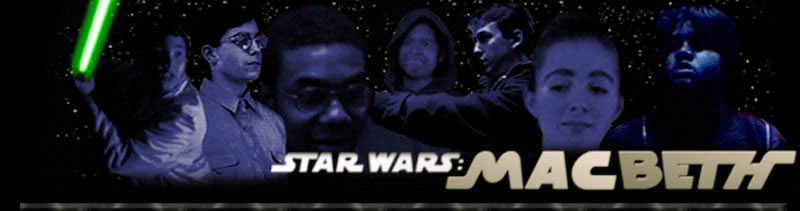
Edition three · 2006–2020
A remastered movie, rebuilt navigation, fuller biographies, and a final home before the domain went dark.
Visit the 2007 capture ↗Filmed and premiered at Glen Ridge High School.
Published to the open Web with downloadable video.
Rebuilt with new formats, news, and outtakes.
Relaunched at DCFR with remastered downloads.
Recovered from local disks, Wayback, and the public record.
Frequently asked since 1998
Macbeth wasn’t created. IT ALWAYS WAS. More precisely: the idea, shoot, edit, and first screenings occupied February and March 1997. The first website followed in August 1998.
Partly. The class supplied the deadline and William S. supplied the plot, but the old FAQ admits the filmmakers would have found an excuse anyway. They had equipment, winter break, and something to prove.
White plastic rods on set, then colored cores and translucent glow painted over each frame in Adobe Premiere. No Toys “R” Us aisle was harmed in the process.
A Sharp Viewcam, the school tripod, one alarmingly hot halogen lamp, a roughly $100 capture card, a low-end Pentium, a rolling school cart as a dolly, and fishing line standing in for the Force.
The AP Chemistry class demanded an immediate replay. By English class the filmmakers knew they had their grade. Copies spread through the building and ordinary schoolwork briefly lost the high ground.
Macduff’s wandering glasses, a dropped saber that mysteriously returns, Carl Erik F. firing at almost everything except the spaceship, and Bienvenido C. standing on a stool to make Darth Macbeth more imposing.
The credits music outlasted the available footage. The soda machine had sustained the production, so it received a thirty-second shrine—just before Pepsi became the official Star Wars sponsor.
You do not need the Force. You need friends, a camera, curiosity, and permission to look a little ridiculous while you learn. A skateboard can be a dolly. A fishing rod can be a visual-effects department.